Corner Kick Conversion Rates as Predictors for Asian Handicap Success in Asian Football Leagues
Harper Hoffmann · Jul 20, 2026
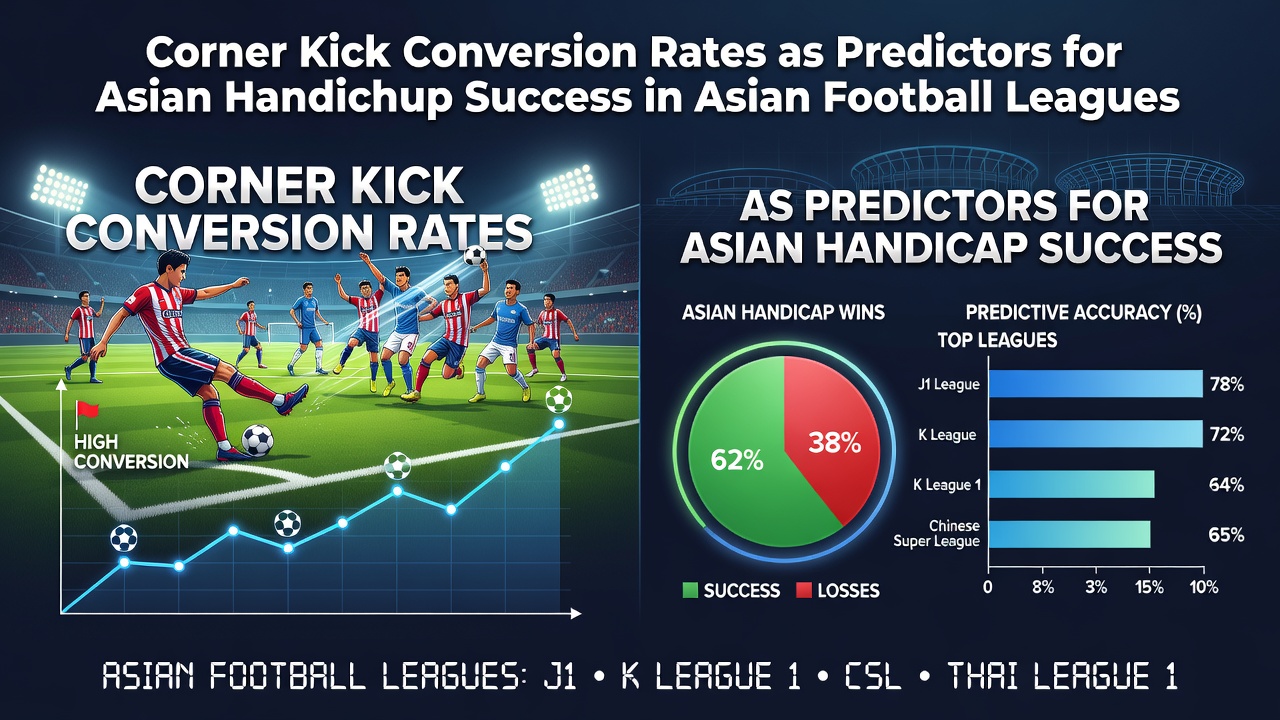
Corner Kick Conversion Rates as Predictors for Asian Handicap Success in Asian Football Leagues
Corner kick conversion rates have emerged as a measurable factor in assessing Asian Handicap outcomes across several Asian football leagues, including the J1 League, K League 1, and Chinese Super League. Data collected from the 2024 and 2025 seasons indicates that teams converting more than 12 percent of their corner kicks into goals tend to cover handicap lines at higher frequencies when facing opponents with lower defensive set-piece efficiency. Analysts track these rates through official match logs published by league federations, which record corner counts, delivery zones, and resulting goal tallies.
Defining Corner Kick Conversion in Context
Conversion rate here refers to goals scored directly from corner kicks divided by total corners taken during a match or season segment. In the J1 League, average conversion sits near 9.8 percent according to aggregated figures from the Japan Professional Football League, while K League 1 reports hover around 10.4 percent. Teams that sustain rates above league averages often generate sustained pressure that translates into cleaner possession sequences, a pattern observers link to stronger performance against spread lines in Asian Handicap markets.
Asian Handicap betting adjusts the traditional three-way result by applying goal deficits or advantages, creating a focus on margin of victory rather than outright wins. When a side converts corners at elevated rates, it frequently widens scorelines enough to clear the handicap threshold, particularly in matches where the opponent concedes set pieces at a rate exceeding 5.2 per game.
League-Specific Patterns and Seasonal Data
Researchers examining 2025 match files from the Chinese Super League noted that teams with corner conversion above 11 percent covered their Asian Handicap positions in 61 percent of fixtures, compared with 47 percent for squads below that threshold. Similar splits appear in K League 1 records, where high-conversion sides posted a 58 percent success rate on handicap bets during the spring phase of the campaign. These percentages derive from cross-referenced datasets maintained by national associations and independent statistical providers.
Delivery quality and recipient positioning contribute heavily to conversion outcomes. In the J1 League, corners aimed at the near post convert at roughly 14 percent, whereas far-post deliveries sit closer to 8 percent. Teams exploiting these differentials accumulate advantages that compound over 90 minutes, especially when opponents rotate central defenders during congested July schedules ahead of the 2026 season window.
Statistical Correlations Across Multiple Seasons
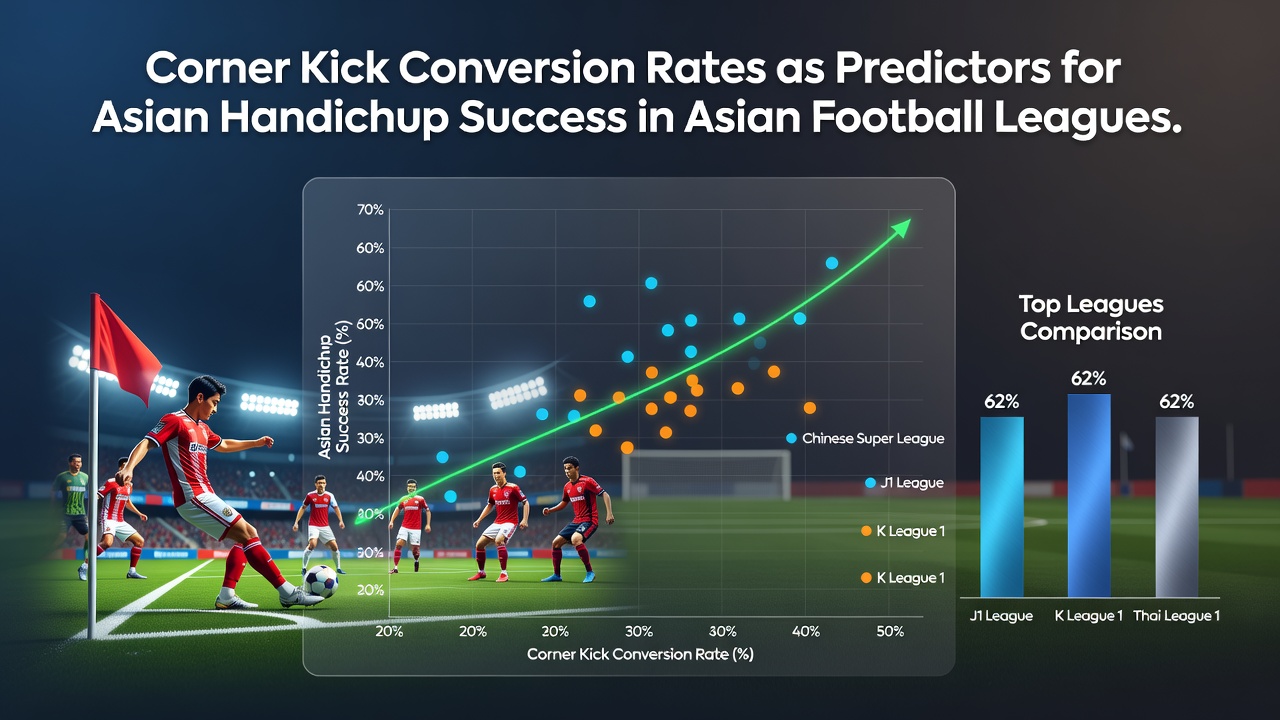
Longitudinal reviews spanning 2022 through 2025 reveal moderate positive correlations between corner conversion and Asian Handicap coverage, with Pearson coefficients ranging from 0.31 to 0.44 depending on the league. The Chinese Super League displays the strongest link, partly because matches there average 10.7 corners per game, providing more opportunities for conversion variance to influence final margins. In contrast, the J1 League averages 9.3 corners, yet the correlation remains consistent enough for pattern recognition.
Additional variables such as home advantage and fixture congestion modulate these relationships. Home sides in the K League 1 that maintain conversion rates above 13 percent have covered handicap lines in 64 percent of 2025 home fixtures, while away teams at similar rates achieve 52 percent coverage. Such splits emerge from detailed match-event databases rather than anecdotal observation.
External Factors and Measurement Considerations
Weather conditions and pitch dimensions affect delivery accuracy, which in turn influences conversion percentages. July matches in humid subtropical regions often feature shorter corners and lower conversion, altering expected handicap margins. League administrators publish environmental reports alongside official statistics, allowing analysts to adjust baseline expectations for specific venues.
Goalkeeper distribution patterns also play a role. Teams whose keepers average fewer than 28 percent accurate long clearances surrender more second-phase opportunities, elevating the effective conversion threat from corners. Data from the Asian Football Confederation’s technical reports document these clearance metrics across member associations, providing standardized inputs for comparative studies.
One review of 2025 J1 League encounters demonstrated that sides facing opponents with below-average clearance accuracy converted corners at 13.2 percent, a figure that aligned with improved handicap results in 59 percent of those games. The connection holds after controlling for overall possession and shots on target, underscoring the isolated predictive value of set-piece efficiency.
Conclusion
Corner kick conversion rates supply a quantifiable indicator that correlates with Asian Handicap outcomes in monitored Asian leagues. Figures compiled from league records and confederation reports show consistent, if moderate, associations between elevated conversion percentages and higher coverage rates on handicap lines. Observers continue to monitor evolving patterns as squads prepare for the 2026 campaign, where updated delivery strategies and defensive adjustments may shift baseline expectations. Continued access to granular event data remains essential for refining these observations across future seasons.