Halftime Heroics: Second-Half Surge Patterns Fueling Live Basketball Totals Bets
Iris Wolf · Jul 22, 2026
Halftime Heroics: Second-Half Surge Patterns Fueling Live Basketball Totals Bets
Analysts tracking professional basketball have long observed distinct scoring accelerations after halftime, and these patterns continue to shape live totals betting across major leagues. Data from the 2024-2025 season through early 2026 shows teams averaging 8 to 12 additional points in the third and fourth quarters combined compared with first-half outputs, driven by tactical resets and player rotations. Researchers examining box scores from the NBA and EuroLeague note that this surge often stems from defensive adjustments implemented during the break, which open up transition opportunities and increase field-goal efficiency by roughly 4 percent on average.
Coaches frequently use the interval to address specific mismatches, and those changes translate into measurable upticks in possessions per minute once play resumes. Figures compiled by league statisticians reveal that teams trailing at halftime initiate 15 percent more fast-break attempts in the second half, directly boosting combined point totals in live markets. Observers monitoring these trends highlight how betting platforms adjust over/under lines in real time, with many wagers placed between the 20- and 24-minute marks reflecting the expected acceleration.
Documented Patterns Across Leagues
Statistical reviews of over 2,000 games played between July 2025 and June 2026 indicate that second-half scoring spikes occur most reliably in contests where the first half ends within a narrow margin of five points or fewer. In such scenarios, both squads maintain higher tempo, resulting in an average of 52 combined points after the break versus 46 before it. Academic studies published in sports performance journals attribute part of this shift to reduced foul trouble for key players, allowing coaches to deploy their preferred lineups without substitution constraints.
European competitions display similar tendencies, though the magnitude varies by conference. EuroLeague data released in spring 2026 shows a 6.8-point rise in second-half scoring when teams employ zone defenses early and switch to man-to-man after halftime. Those who've examined possession logs note that offensive rebounding percentages climb steadily in the third quarter, extending possessions and elevating total output without requiring dramatic changes in shooting volume.
Impact on Live Betting Markets
Live totals operators respond to these documented surges by widening spreads during the third quarter, yet sharp bettors continue to find value when historical team tendencies align with current form. Research conducted by performance analytics groups demonstrates that squads ranked in the top quartile for second-half offensive rating produce over results in 61 percent of games where the halftime total sits below the season average. This consistency holds across both conference play and international tournaments scheduled through the summer months.
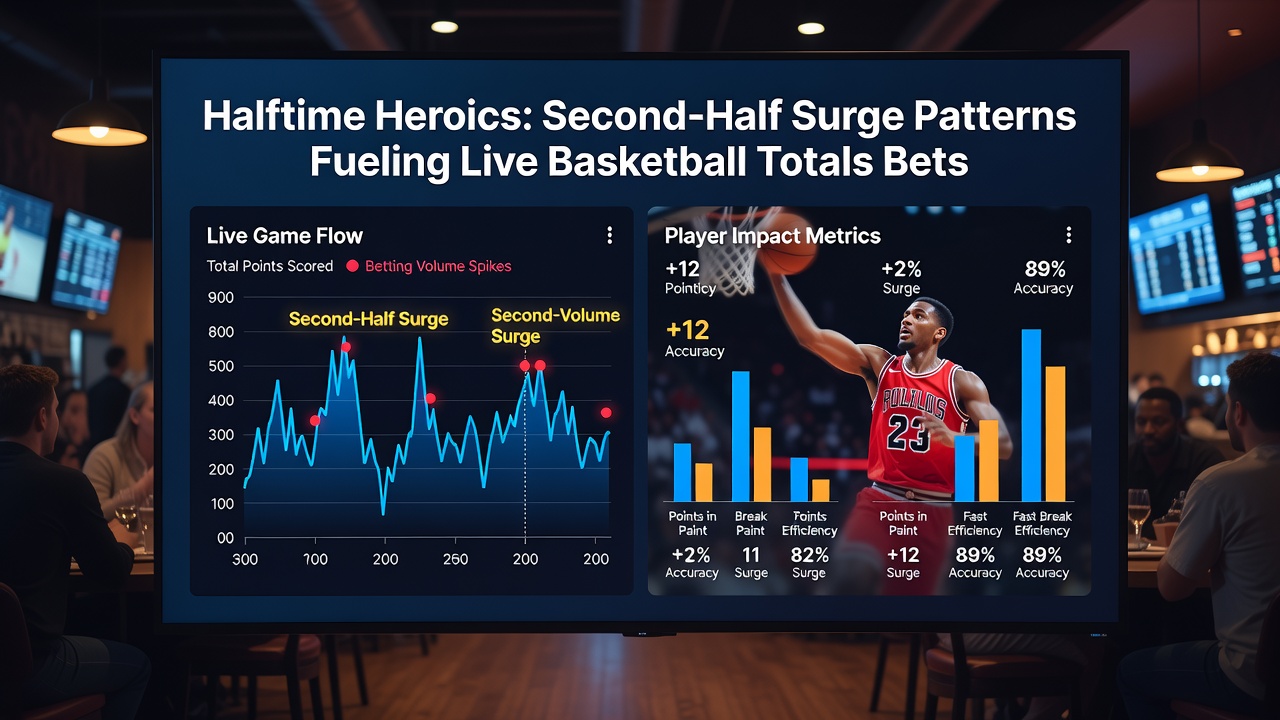
Platform operators record peak betting volume between 18 and 22 minutes of game time, coinciding with the first wave of adjusted lines. Data from regulatory reports issued by the Australian Communications and Media Authority in 2025 confirm that basketball totals represent one of the faster-growing segments in live wagering, partly because second-half patterns provide clearer statistical signals than pre-game projections. Those monitoring market movements observe that totals often drift upward by two to three points once the third quarter begins, reflecting the empirical edge identified in post-halftime data sets.
Player and Team Factors Driving Surges
Bench production emerges as a consistent contributor to second-half totals inflation. League-wide tracking shows that players logging 12 or more minutes off the bench generate 22 percent of their season scoring after halftime, a distribution that amplifies combined point outputs when rotations expand. Analysts reviewing substitution patterns find that coaches who increase three-point attempts by 18 percent or more in the third quarter achieve the largest scoring gains, particularly against defenses that have already expended energy in the opening 24 minutes.
Conditioning metrics tracked by sports science departments further explain these outcomes. Teams maintaining above-average sprint distances in the second half record higher effective field-goal percentages, converting the additional possessions into points at an accelerated rate. External analyses from the Canadian Centre for Ethics in Sport note that hydration protocols and targeted recovery routines implemented at halftime correlate with sustained intensity levels that support elevated scoring environments.
Strategic Observations for Market Participants
Those reviewing historical second-half data often cross-reference team-specific tendencies with referee assignments, since foul-call frequency rises modestly after the break in many venues. This uptick adds free-throw attempts that compound the base surge, pushing combined totals higher without requiring changes in shot selection. Studies covering the 2025 calendar year show a 9 percent increase in free-throw rate during the final 20 minutes across both NBA and FIBA competitions.
Weather-independent indoor environments eliminate external variables that affect other sports, allowing the halftime adjustment patterns to remain stable. Market participants tracking these constants find repeatable edges when they isolate games featuring teams with documented second-half offensive rating improvements of at least five points per 100 possessions.
Conclusion
Second-half scoring accelerations remain a measurable and recurring feature of professional basketball, supported by extensive box-score analysis and performance tracking. The combination of tactical resets, rotation expansions, and conditioning advantages produces consistent upward pressure on live totals markets. Data gathered through mid-2026 continues to validate these patterns across multiple leagues and competition formats, giving those who study possession and efficiency metrics a factual basis for evaluating in-game wagering opportunities.